Category: Dog News

The latest dog news from around the world

  • Vitally Important Pet Theft Petition Reaches 140,000 signatures

    Vitally Important Pet Theft Petition Reaches 140,000 signatures

    The 4th September marked the end of the third petition to reach over 100,000 signatures in the last three years demanding that the theft of a pet be reclassified and comes at a time when Dog Lost, the country’s leading pet reunification organisation have seen a dramatic increase in dog theft primarily due to the escalating price of puppies and it has reached such a pitch that police forces and councils around the country are asking dog owners to be vigilant at all times.

    Arnot Wilson of the Stolen & Missing Pets Alliance (SAMPA) said “This increase in theft is set to continue because of the new legislation on breeding and welfare together with charities encouraging the adopting of dogs from rescue centres and the absence of tougher penalties for pet theft. Until the law is rectified I am afraid it’s no longer lock up your daughters but lock up your dogs.”

    In July, responding to the Petitions Committee’s letter following the 2019 petition, the Secretary of State for Justice, Rt Hon Robert Buckland said that stealing a pet is already a criminal offence under the Theft Act 1968 for which the maximum penalty is 7 years’ imprisonment.

    Dr Daniel Allen, Animal Geographer, of Keele University and author of the three successful petitions said “The 7 years’ imprisonment is totally misleading even the Government agree that the penalty to use their words ‘is largely theoretical unless there are other aggravating circumstances’ so in practice it will never be applied.

    As the sentencing guidelines currently stand, it will be impossible to secure a custodial sentence for most pet thefts because of the benchmark value of £500.

    Reality is, a custodial sentence is unlikely to apply unless it is a secondary offence used to justify and bolster a harsh primary sentence. This has to be changed and with the Government accepting “pets are sentient beings and more than just property” then it can not be beyond their means to reclassify pets into a category of their own as is the case for motor vehicles and bicycles.

    This change would give courts access to appropriate custodial sentences which would act as a deterrent and provide a punishment that reflects the impact of the crime.”

    “Third time lucky for our pets?” asks Debbie Matthews, founder of Vets Get Scanning and chairperson of the Stolen & Missing Pets Alliance. She said “Pet owners have yet again demonstrated their wish to see the Theft Act amended to include a separate definition for our pets, this simple amendment is not a big deal for Government to deliver. We desperately need a suitable deterrent to stop this vile crime and the misery that it causes”.

    Following the success of the third petition, the Stolen and Missing Pets Alliance are asking all pet owners to contact their MPs to get their support to make the Government amend the law. For more information visit their website: https://www.stolenandmissingpetsalliance.co.uk/write-to-your-mp/
  • Vetoquinol Acquires Two Major Pet Wormer Brands

    Vetoquinol Acquires Two Major Pet Wormer Brands

    Northamptonshire based Vetoquinol has announced its acquisition of Profender® and Drontal®, the broad spectrum dewormers for cats and dogs and is now the new owner of the brands in the UK and Ireland.

    The brands were acquired by Vetoquinol following recent mergers between Bayer Animal Health and Elanco.

    The popular pet brands come into the fold at Vetoquinol with a strong heritage and reputation.

    Caitrina Oakes, Vetoquinol Managing Director UK and Ireland, says she is delighted to have brought the brands into the Vetoquinol portfolio and believes they are a natural fit for the company.

    “Vetoquinol has long held a reputation for delivering therapeutic products that extend the capability of clinicians to treat and manage disease. Preventative care is also playing an increasingly central role in practices, with the emphasis on helping pets live longer, healthier, happier lives. With many pet owners spending more hours than ever with their pets during lockdown, companion animal parasiticides have never been more important.”

  • MP Robert Buckland QC Shows Just How Out of Touch the Government Really Is With This Statement on Pet Theft Crime

    MP Robert Buckland QC Shows Just How Out of Touch the Government Really Is With This Statement on Pet Theft Crime

    MPs on Parliament’s Petitions Committee have expressed disappointment at the Government’s response to their call to make pet theft a specific criminal offence.

    Last month, following a string of petitions with more than 250,000 signatures, the Petitions Committee called for the Government to ensure the value of pets is fully recognised in the law and for pet theft to be made a specific crime.

    In a letter to the Secretary of State for Justice, Committee Chair Catherine McKinnell MP and Committee member Tom Hunt MP urged Ministers to ensure that sentencing options available to courts acted as a real deterrent for those who commit pet theft crimes. The letter also set out options for the Government on how to achieve this, and urged Ministers to take urgent action to amend legislation.

    Formally responding to the Committee in a letter published today [30/07/2020], the Rt Hon Robert Buckland QC MP, acknowledged the impact of pet theft as causing “deep distress” for pet owners. The Minister also said he recognised the “strength of feeling among campaigners regarding this issue” but reiterated that the Government has no plans to take further action in terms of legislation against those committing acts of pet theft. In his letter, the Secretary of State for Justice stated he was satisfied that current laws cover the crime of pet theft.

    The response from the Government comes as recent research by DogLost showed thefts surged 65% amid lockdown – compared with the same period last year. The figures will add to concerns raised by pet theft reform campaigners, whose research has shown that the number of thefts is continuing to increase year-on-year.

    Expressing disappointment at the response from the Government, Chair of the Petitions Committee, Catherine McKinnell MP, said:

    “Pet theft is a truly callous crime. It strikes at the heart of families and the evidence is showing that every year the Government fails to take action the problem is getting worse.

    “With the issue of pet theft now spiralling, it is incredibly disappointing that the Government have decided against taking action and bringing forward tougher sentencing for this awful crime.

    “Petitioners have been pressing Parliament and the Government on this issue since 2018, with more than 250,000 signatures on petitions urging action to be taken.”

    Petitions Committee Member, Tom Hunt MP, said:

    “Pet theft is a particularly cruel crime, robbing people of a cherished source of companionship and causing untold harm to the animals themselves.

    “I’m disappointed the Government has set out that it has no plans to make pet theft a specific offence in its response to the virtual discussion I chaired with the campaigners behind the Pet Theft Reform Petition.”

    Commenting specifically on the (typically unenforced ref. pet thefts) 7 year sentencing outlined by Robert Buckland QC in his letter, Tom Hunt MP said:

    “In the absence of a specific offense for pet theft, pets are classed by the law as inanimate objects, with their theft usually resulting in no more than paltry £250 fines. This punishment simply doesn’t reflect the serious nature of the crime.

    “I’m firmly of the view that the law doesn’t reflect where the public is on this issue, and I will be pushing for Pet Theft Reform to get the debate in Parliament it deserves after the recess.”

    Concerned campaigners for pet theft reform took part in a discussion last month with Petitions Committee Member Tom Hunt MP. Among those discussing the growing issue of pet theft were experts and academics in the field including John Cooper QC and Keele University academic Dr Daniel Allen, who has launched three separate petitions on the issue [watch the discussion here].

    The letter sent last month by the Petitions Committee calls for the Government to bring forward legislation, by amending either the Theft Act or the Animal Welfare Act, to create a specific new offence of pet theft with an appropriate sentencing range to deter thieves and provide a punishment that reflects the true impact of pet theft.

    It’s fair to say the Government haven’t heard the end of this. 

    “With significant cross-party consensus and public support on this issue, the Petitions Committee will continue to raise it with the Government and look to ensure there is opportunity to challenge their response by scheduling a Parliamentary debate to ensure the petitioners concerns continue to be heard,” concluded Catherine McKinnell MP.

  • How Crucial Was Your Dog to Your Happiness During Lockdown?

    According to a new study, 8 in 10 dog owners said their pet was extremely important to their mental wellbeing during the UK’s lockdown and believe their dogs were largely happy, some did admit that their dog wasn’t his usual self as a result of being indoors for longer periods of time with the whole family.

    The findings have been shared by natural pet treat brand Pet Munchies, which also learnt half of dog owners made sure their dog had extra play sessions, 4 in 10 dog owners took more walks and almost a third chose to keep their dogs stimulated and occupied at home by teaching them new tricks!


    Natasha and Toto / Photo Credit: Natasha Wise

    Natasha Wise is a three-time world agility champion. She explains the benefit to a dog’s mental wellbeing from having stimulation, such as learning a new skill to get the mind whirring, during unusual times like these.

    “Stimulation focuses a dog’s brain on the desired game and reduces stress, anxiety, and associated unwanted behaviours. As a result, through mental stimulation, dogs become happier resulting in calmness and settling around the home after a period of stimulation.

    “The best training tip I can give is to find out what makes your dog tick and include that in your teaching as a reward you know your dog will love. My dogs have a particular favourite brand, Pet Munchies, they’re very versatile and my dogs love them so I always have them to hand.”

    So, This Is How Dogs Spent Lockdown Is It? 2
    Natasha’s dog Toto in training / Photo Credit: Natasha Wise

    The most popular tricks taught by dog owners include playing hide and seek, sit/stay, roll over and giving a paw on command. Some ambitious owners admitted that they taught their dog to tidy their toys up behind themselves, to fetch the TV remote and even to read!

    And to reward their pets for learning fun, and sometimes practical, new skills, dog owners treated their dogs to their favourite food and treats, lavished hugs, kisses and affection on their clever dogs and a few lucky dogs were even gifted new toys.

    Dog trainer Cat Donald had to temporarily close her business during the lockdown. She told K9 Magazine that she decided to teach her two-year-old Labrador Retriever, Skye, a new trick that she could use every day – to fetch her lead.

    “Without Skye, lockdown would have been much harder to get through, she’s made it a bearable experience and the bond with my dog has definitely grown for the better,” says Cat.


    Cat Donald and Skye / Photo Credit: Cat Donald

    Ryan O’Meara shared this piece of advice to help dog owners help their dogs to beat post-lockdown blues:

    “For dogs that have gotten used to the specific routine of having their owners around, it may be jarring for them when it suddenly and abruptly ends.

    “Dogs love being with their family, so less time spent with their owners can make them sad. Re-establishing routine is the key component for making sure our dogs don’t suffer the post-lockdown blues.”

  • So, This Is How Dogs Spent Lockdown Is It?

    So, This Is How Dogs Spent Lockdown Is It?

    A new study by Pet Munchies has revealed how the UK’s dogs spent lockdown – and it’s very sweet, except more dogs than ever will now be hiding from their owners – and some dogs will now even be tidying up behind themselves! Is your dog one of them?

    According to the natural pet treat brand, 8 in 10 pet owners said that their dogs were very important for their mental wellbeing during the lockdown and admitted that without their pets for company, it would have been a very different experience.

    However, while 77 per cent of dog owners believe that their dogs were very happy during the lockdown, not all were so sure and 8 per cent admitted that their dogs were not their usual selves, putting this down to having to spend longer periods of time indoors and more time with the whole family at home2, something that under usual circumstances, would be limited for dogs to experience due to members of the family leaving home to go to school or work.

    Former professional dog trainer Ryan O’Meara explained why this might impact on a dog’s happiness:

    “Dogs are happiest and most content when they are in a routine. When dogs are used to days following specific patterns – wake up, breakfast, walk, kids leave to go to school, and so on, it can be something to overcome when patterns of behaviour change because it’s a shift to what they knew to be their family’s routine.”


    Ryan training his two dogs, Chloe and Mia / Photo Credit: Ryan O’Meara

    How dog owners attempted to make lockdown fun for their pets

    In a bid to repay dogs for their crucial role to their happiness, half of pet parents admitted that they spent more time playing with their dogs at home, while 4 in 10 took in more walks and almost a third (29 per cent) decided to keep their dog’s brains stimulated by teaching their dog new skills with a third (31 per cent) declaring they’ve taught their dog one-two new tricks.

    The most popular tricks taught by dog owners include playing hide and seek, sit/stay, roll over and giving a paw on command. Some ambitious owners admitted that they taught their dog to tidy their toys up behind themselves3, to fetch the TV remote and even to read!

    And to reward their pets for learning fun, and sometimes practical, new skills, 72 per cent of dog owners treated their dogs to their favourite food and treats, 66 per cent lavished hugs, kisses and affection on their clever dogs and 11 per cent of owners gifted their dogs new toys.

    UK dog owners taught their dogs these fun games & tricks during lockdown

    • Hide and seek
    • Sit/stay
    • Give paw
    • Roll over
    • Tidying up (putting toys away)
    • Fetch keys/TV remote
    • Learning to read

    Source: Pet Munchies

    Other popular brain puzzles and activities favoured by dogs and their owners included learning how to fetch their lead, fetching specific toys and learning agility, one of the UK’s most popular dog sports.

    Natasha Wise is a three-time world agility champion. She explains the benefit to a dog’s mental wellbeing from having stimulation, such as learning a new skill to get the mind whirring, during unusual times like these.


    Natasha’s dog Toto in training / Photo Credit: Natasha Wise

    “Stimulation focuses a dog’s brain on the desired game and reduces stress, anxiety, and associated unwanted behaviours. As a result, through mental stimulation, dogs become happier resulting in calmness and settling around the home after a period of stimulation.

    “The best training tip I can give is to find out what makes your dog tick and include that in your teaching as a reward you know your dog will love. My dogs have a particular favourite brand, Pet Munchies, they’re very versatile and my dogs love them so I always have them to hand.”

    Ryan O’Meara shared this final piece of advice to help dog owners help their dogs to beat post-lockdown blues:

    “For dogs that have gotten used to the specific routine of having their owners around, it may be jarring for them when it suddenly and abruptly ends.

    “Dogs love being with their family, so less time spent with their owners can make them sad. Re-establishing routine is the key component for making sure our dogs don’t suffer the post-lockdown blues.”

  • Pet Owners Believe Dogs Crucial to Mental Wellbeing During Lockdown

    Pet Owners Believe Dogs Crucial to Mental Wellbeing During Lockdown

    A new study has revealed how the UK’s dogs spent lockdown – and it’s very sweet, except more dogs than ever will now be hiding from their owners – and some dogs will now even be tidying up behind themselves!

    According to new research by natural pet treat brand Pet Munchies, dog owners said that without their pets for company, it would have been a very different experience, with  8 in 10 pet owners said that their dogs were very important for their mental wellbeing during the lockdown.


    Toto in training / Photo Credit: Natasha Wise

    However, while 77 per cent of dog owners believe that their dogs were very happy during the lockdown, not all were so sure and 8 per cent admitted that their dogs were not their usual selves, putting this down to having to spend longer periods of time indoors and more time with the whole family at home2, something that under usual circumstances, would be limited for dogs to experience due to members of the family leaving home to go to school or work.

    Former professional dog trainer Ryan O’Meara explained why this might impact on a dog’s happiness:

    “Dogs are happiest and most content when they are in a routine. When dogs are used to days following specific patterns – wake up, breakfast, walk, kids leave to go to school, and so on, it can be something to overcome when patterns of behaviour change because it’s a shift to what they knew to be their family’s routine.”


    Ryan whistle training his two dogs, Chloe and Mia / Photo Credit: Ryan O’Meara

    How dog owners attempted to make lockdown fun for their pets

    In a bid to repay dogs for their crucial role to their happiness, half of pet parents admitted that they spent more time playing with their dogs at home, while 4 in 10 took in more walks and almost a third (29 per cent) decided to keep their dog’s brains stimulated by teaching their dog new skills with a third (31 per cent) declaring they’ve taught their dog one-two new tricks.

    The most popular tricks taught by dog owners include playing hide and seek, sit/stay, roll over and giving a paw on command. Some ambitious owners admitted that they taught their dog to tidy their toys up behind themselves3, to fetch the TV remote and even to read!

    And to reward their pets for learning fun, and sometimes practical, new skills, 72 per cent of dog owners treated their dogs to their favourite food and treats, 66 per cent lavished hugs, kisses and affection on their clever dogs and 11 per cent of owners gifted their dogs’ new toys.

    Most popular dog tricks/games taught by owners in lockdown

    1. Hide and seek
    2. Sit/stay
    3. Give paw
    4. Roll over
    5. Tidying up (putting toys away)
    6. Fetch keys/TV remote
    7. Learning to read

    Source: Pet Munchies

    Other popular brain puzzles and activities favoured by dogs and their owners included learning how to fetch their lead, fetching specific toys and learning agility, one of the UK’s most popular dog sports.

    Natasha Wise, pictured below, is a three-time world agility champion. She explains the benefit to a dog’s mental wellbeing from having stimulation, such as learning a new skill to get the mind whirring, during unusual times like these.


    Natasha and Toto / Photo Credit: Natasha Wise

    “Stimulation focuses a dog’s brain on the desired game and reduces stress, anxiety, and associated unwanted behaviours. As a result, through mental stimulation, dogs become happier resulting in calmness and settling around the home after a period of stimulation.

    “The best training tip I can give is to find out what makes your dog tick and include that in your teaching as a reward you know your dog will love. My dogs have a particular favourite brand, Pet Munchies, they’re very versatile and my dogs love them so I always have them to hand.”

    Ryan O’Meara shared this final piece of advice to help dog owners help their dogs to beat post-lockdown blues:

    “For dogs that have gotten used to the specific routine of having their owners around, it may be jarring for them when it suddenly and abruptly ends.

    “Dogs love being with their family, so less time spent with their owners can make them sad. Re-establishing routine is the key component for making sure our dogs don’t suffer the post-lockdown blues.”

  • Devon Dog’s Cliff Rescue After Trying to Retrieve Stick and Falling Into Water

    Devon Dog’s Cliff Rescue After Trying to Retrieve Stick and Falling Into Water

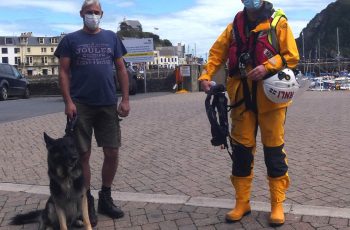
    A German Shepherd named Marley was walking by the cliff edge at Bull Point in Ilfracombe, Devon and dropped his stick, which then tumbled over the edge.

    Marley went over the cliff edge to retrieve his stick but ended up falling into the water and could not get out. His owner found a different route safely down but then could not get back up the cliff again.

    Marley and his owner travelling back to safety with the RNLI / Photo Credit: Nikki Bradshaw

    Two Coastguard rescue teams were also called to the incident as well as the Newquay Coastguard helicopter. The all-weather lifeboat was first to arrive on the scene and the Coxswain Carl Perrin instructed for the inflatable X-class boat to be put in the water, with a line keeping it secured to the ALB, so they could reach the shore.

    Two crew members took the X-class to the shore, where the casualty and dog were both uninjured. They were brought to the ALB on the X-class, with the two crew members swimming back to the lifeboat so they could remain socially distant. The lifeboat was then back at the station around 12.25pm.


    Marley and his owner back on land / Photo Credit: Nikki Bradshaw

    After the rescue, Marley’s owner said: ‘I really can’t thank the RNLI enough for coming to help us.’

    Coxswain Carl Perrin is reminding dog owners to be cautious, saying: ‘We would like to remind everyone to please keep their dogs on leads if they’re walking close to cliff edges and remember the best thing to do if your pet gets into trouble at the coast is don’t enter the water yourself, instead call 999 and ask for the Coastguard. We’re all very glad there was a positive outcome in this case.’

  • Scotland Introduces 5 Year Sentencing for Animal Cruelty, Will England & Wales Follow?

    Scotland Introduces 5 Year Sentencing for Animal Cruelty, Will England & Wales Follow?

    Members of the Scottish Parliament have voted to raise the maximum sentence for animal cruelty in Scotland from 12 months to five years. The Bill will become law after it receives Royal Assent.

    The Animals and Wildlife (Penalties, Protections and Powers) (Scotland) Bill was first introduced in the Scottish Parliament in October 2019 and it has now passed its third and final reading.

    Charities have been campaigning to raise Scotland’s maximum sentences to five years, in line with many other countries in Europe.

    Research published by Battersea in 2017 showed that the maximum sentence of 12 months for animal cruelty was among the lowest across the whole of Europe – with only five other countries having lower sentences (including England and Wales). Both fly-tipping and theft carried higher sentences.

    Battersea’s Chief Executive, Claire Horton CBE, said: “This change would not have happened without everyone’s support. Now we desperately need England and Wales to follow in the Scots’ footsteps.”

    In England and Wales, where the maximum punishment for animal cruelty is the lowest in Europe at just six months, the Westminster Bill has been postponed yet again; despite the Government first pledging its support almost three years ago in 2017.

    The Bill has been published twice before but fell during the prorogation of Parliament in October 2019, and a second time when a general election was called in December.

    A Private Member’s Bill brought in by Chris Loder MP is currently seeking to introduce these measures, but this month (June), it was delayed until 23 October 2020 – five months after its original date for discussion in Westminster.

    If you feel strongly that the next discussion should not be delayed, write to your MP and encourage them to support and do what they can to push and avoid further delays.

  • WATCH: Andrew Cotter Narrates Cavapoo’s Stealthy Moves in New Video for Charity

    WATCH: Andrew Cotter Narrates Cavapoo’s Stealthy Moves in New Video for Charity

    Renowned BBC sports commentator Andrew Cotter, who has been entertaining us all through lockdown with videos of his own dogs Olive and Mabel, has created his latest hilarious video with a dog named Nala for a good cause .

    UK-wide charity Dogs for Good launched their #WinningFromHome competition three weeks ago which asked entrants to post a video, on Twitter, of their own companion dog during the Covid-19 lockdown, as part of the charity’s ongoing efforts to highlight the power of dogs.

    Each entrant donated £2 and over £1,000 has been raised to date. This money will help Dogs for Good train assistance and community dogs to live more independently.

    The winning video shows one-year-old Cavapoo, Nala, as she attempts to catch a bird in the garden, and Andrew describes her as having “the stealth of a sofa moving across the lawn”.

    He explains why he chose her video as the winner: “Sport has tension, anticipation, build-up, bursts of activity, concentration and drama and Nala’s quest delivers all of those things.

    “Like any serious competitor, she’s absolutely focused on the job in hand and her commitment shines through.”

    He added: “I chose to support Dogs for Good because the charity celebrates the inherent good in dogs and champions the power of the human-dog bond.

    “It trains dogs to help people with a wide range of disabilities and those partnerships go on to change lives.”


    Andrew Cotter with his dogs, Mabel and Olive

    Nala’s owners Joe and Ruth Daniels, from Chingford in Essex, who have three children Caspar, Milla and Arthur, were thrilled to win this competition and love Andrew’s commentary.

    Initially Ruth was wary about getting a dog but bowed to pressure from Caspar, and now they can’t imagine life without Nala as she’s brought so much happiness to the family.

    Joe Daniels said: “I wasn’t aware of Dogs for Good as a charity before lockdown and the competition has been a lovely introduction to the very special, life-changing work it carries out.

    “Nala’s a funny little thing and has a lot of character. She’s playful, determined and very much her own dog. During lockdown, she’s kept us all entertained in a number of ways and when she does her ‘bird dog’ thing, it’s turned into something of a family spectator sport.

    “Andrew’s commentary is perfect and he’s done Nala’s efforts proud. The build, the tension, the humour, the whole nine yards. It’s such a special thing to have happened during lockdown and is a memory that we’ll really treasure.”


    The Daniels family with Nala

    Dogs for Good Chief Executive, Peter Gorbing, said: “We’re all really thrilled to have worked with Andrew Cotter on this competition and well done to our very worthy winner, Nala.

    “The competition highlights the fact that now, more than ever, dogs have a huge part to play in keeping the human spirit buoyed. They have anchored so many of us through lockdown by simply being dogs and offering us their unconditional and life-changing devotion.”

  • For the First Time in Six Years, Dog Thefts Seem to Be on the Decline – But Dogs ARE Still Being Stolen

    For the First Time in Six Years, Dog Thefts Seem to Be on the Decline – But Dogs ARE Still Being Stolen

    New research from Direct Line Pet Insurance reveals that, for the first time since the study began in 2014, there has been a year-on-year fall in the number of dogs reported stolen across England and Wales.

    In 2019, an estimated 2,026 dogs were reported as stolen to police forces, a fall of 23 per cent compared to 2018 (2,625).

    But despite this good news, on average, six dogs were still reported as stolen every day and for the sixth year in a row, Staffordshire Bull Terriers are the most popular breed of dog to be targeted by thieves, with 89 dogs stolen in 2019.

    UK dog theft statistics 2019

    Crossbreeds remain the second most commonly targeted, although the number stolen in 2019 increased substantially, by 42 per cent. This is perhaps partly due to the popularity and expense of so-called designer dog breeds like Puggles and Schnoodles.

    Chihuahuas remained in third place in the table, although with a slight reduction (four per cent) in numbers stolen compared to 2018.

    Yorkshire Terriers, which did not make it into the top 10 most commonly stolen breeds in 2018 are now sixth, with triple the number stolen in 2019. This may be partly due to their popularity among well-known celebrities such as Serena Williams, Simon Cowell and Steven Tyler.

    Lurchers and Border Collies were also outside the top 10 in 2018 but are both now among the most popular targets for thieves.

    Breeds that have fallen in popularity for dog thieves include French Bulldogs, Jack Russell Terriers and Pugs.

    Eva Sandstra-Bennett, Head of Pet Insurance at Direct Line, said:

    “It is encouraging to see that the number of dogs stolen has fallen over the last year and, during the current lock down period, we expect this to drop even more. There is a risk, however, that these numbers may start to rise again as Lucy’s Law which came into force in April restricting sale of puppies from third parties, could result in some thieves having to take drastic measures to access certain breeds.

    “Dogs are such an important part of our lives, so to have one stolen is like losing a member of the family. We urge dog owners to be extra vigilant while out on their walks or in the car and not leave their beloved pets alone. Simple steps like not tying dogs outside of shops or leaving them in cars can help reduce the likelihood of becoming a target for thieves.”

    In more positive news for dog owners, the number of dogs returned to their owners in 2019 increased and means nearly one in five stolen dogs were recovered.

    Areas of the UK most at risk from dog thieves, according to police data

    London and the South East remained the dog theft hotspots in England and Wales, with the two regions accounting for a third of all reported cases of dog theft last year.

    West Yorkshire Police received the second greatest number of reports (167) of stolen dogs in 2019, while Kent saw the third-highest with 100 reports.

    Both forces, however, received fewer reports of stolen dogs in 2019 compared to 2018, a reduction of seven per cent and four per cent respectively.

    Alongside the Metropolitan Police, the top 10 police forces which saw increases in the number of dogs stolen in 2019 were Leicestershire Constabulary, West Mercia Police, Essex Police and Durham Constabulary.

    Dyfed-Powys Police returned the greatest proportion of dogs to their owners last year, reuniting 26 out of 33 dogs with their owners, a success rate of four in five dogs.

    Eva Sandstra-Bennett, Head of Pet Insurance at Direct Line, continued:

    “It is great to see that the number of dogs returned to their owners is on the rise across the country, giving hope to those who have had their dog stolen. The positive changes in the law in recent years, such as microchipping become a legal obligation, will have contributed to the improvements in reuniting owners with their lost pets and we hope that this continues in the coming years.”

    What to do if your dog is stolen

    1. Check the local area and your dog’s favourite spots as your dog may have wandered off.

    2. Make your dog ‘too hot to handle’ by sharing on social media, putting up posters in the local area and informing local media – include pictures and any distinctive marks in any appeals, and ask others to spread the word.

    3. There are some specific sites set up to help find lost and stolen dogs, like doglost.co.uk.

    4. Report your dog as stolen to the police and provide them with as much detail as possible.

    5. Report your dog as stolen to local pet related services like vets, animal shelters, pet shops, dog wardens and the council. Provide photos, a physical description and the dog’s microchip number
    Report your dog to the microchip database.

    Dog theft statistics UK (2019): summary

    • Six dogs are stolen every day, according to Direct Line Pet Insurance.
    • More dogs are stolen in London and the South East than any other region in England and Wales. Behind London, West Yorkshire is a hot spot for dog thefts in the UK, according to police data.
    • Staffordshire Bull Terriers are the most targeted dog breed by dog thieves, followed by cross-breeds and Chihuahuas.
    • In 2019, one in five stolen dogs were recovered and reunited with their families. Dyfed-Powys Police in Wales returned the greatest proportion of dogs (four in five) to their owners last year.
  • Watch These Dogs Being Trained To Spot Coronavirus (Video)

    British dogs are being trained in the detection of coronavirus.

    The dogs are being utilised as the world hunts for early detection methods for spotting coronavirus infections in humans. Watch the dogs being put through their paces in this fascinating video.

  • What Is Tuks Law?

    What Is Tuks Law?

    A petition has launched in the name of a rescue dog named Tuk in a bid to create a new law that would mean vets would be legally required to scan for rescue back up contact details on microchips and confirm the person presenting the animal is registered on the microchip prior to euthanising a healthy or treatable animal.

    In the case of Tuk, this appears not to have happened when he was taken to a veterinary practice and as such, he was put to sleep without his back up rescue being contacted.

    What Tuks Law Is Calling For

    The petition has been started to make it law that no healthy animal can be destroyed by a vet without first scanning the pet’s microchip to confirm the person requesting euthanasia has the authority to do so and that the dual registration contact detail (i.e. an animal rescue and owner) on the microchip is contacted and honoured.

    This is relevant because typically animal rescues microchip pets in their care at the time of carrying out essential healthcare treatments, such as vaccinating and spaying/neutering. This usually occurs before new owners have been found for the pet and so the details registered for microchips belong to the rescue.

    Once animals are rehomed, rescues remain a presence in their life, offering rescue back up to new owners for the duration of the pet’s life. They are on hand for advice and should owners no longer be able to cope or care for the pet, the rescue’s contract typically stipulates the pet returns to their care where they will find alternative care. This is to prevent the pet from being sold on by owners, as appears to have been the case for Tuk (without his back up rescue’s knowledge).

    Tuks Law would also request that vets seek alternative options in non-life threatening/non-emergency situations.

    On behalf of the petition, a spokesperson said: “We recently met with Zac Goldsmith from DEFRA to discuss our concerns and we are also awaiting the revised response from the government regarding the petition as the petition committee agreed with us that the original response was not addressing the main points of concern.

    “We have also recently met with Niall Cornell the president of the RCVS who disappointedly was not aware that rescue organisations dual register their contact details on microchips or offer rescue back up in times of vulnerability.”

    Read more about the petition here.

  • Animal Rescues in England Can Begin Rehoming Again (Here’s a Blueprint from the RSPCA)

    Animal Rescues in England Can Begin Rehoming Again (Here’s a Blueprint from the RSPCA)

    New UK Government approved guidelines allowing safe rehoming and fostering means animal charities can start finding homes for animals in England, the RSPCA says.

    Frontline teams from charities, including the RSPCA, have continued to rescue animals throughout the crisis but they have been unable to find them new homes, meaning that thousands have remained in its care.

    Now Defra has approved guidelines, put together by the Canine and Feline Sector Group, to allow animal welfare charities in England to rehome safely during the pandemic.


    Polly is in the care of Greyhound Gap and looking for a new home

    The RSPCA will start finding homes for the animals in its care using a new safe process in line with Defra-approved guidance for England, which includes:

    – Completing adoption/inquiry forms online

    – All adopters or fosterers must live within about an hour’s drive of the centre where the animal is being cared for

    – All discussions will take place via phone or video call

    – Adopters and fosterers will get to ‘virtually meet’ their potential pet with videos sent to show them their behaviour and give them a deeper understanding of their pet’s personality

    – Home visits will be done virtually, through photos or video walk-through the home

    -All pets will be transported to their new homes and handovers will observe social distancing

    The RSPCA says its animal centres will remain closed to the public until further notice. Full guidance from the Canine and Feline Sectory Group is available here and recommended reading for relevant animal rescues.

    The UK’s largest dog adoption website, dogsblog.com, is trialling a video initiative to help rescues looking to begin using video regularly as part of its adoption process.

    If you are a rescue looking to start using video or looking to adopt a dog and willing to take part in the trial, please contact dogsblog.com by emailing here to take part.

  • Shenzen Bans Consumption of Dogs, Cats & Wildlife, Which Cities Will Follow?

    Shenzen Bans Consumption of Dogs, Cats & Wildlife, Which Cities Will Follow?

    China’s city of Shenzhen has just passed a ground-breaking law to ban the consumption and production of dog and cat meat, the first city in China to do so. The ban has been welcomed by long-time anti-dog meat trade campaigners Humane Society International as a watershed moment in efforts to ban the trade across China.

    The food safety legislation (Shenzhen Special Economic Region Regulation on a Comprehensive Ban on the Consumption of Wild Animals) proposed in February by Shenzhen legislators, comes into effect on 1st May.

    A dog rescued from a Yulin slaughterhouse, pictured at a rescue shelter in North China / Photo Credit: HSI

    Unlike the temporary ban on wildlife markets and consumption passed by the national government, Shenzhen’s ban is a permanent prohibition on the consumption, breeding, and sale of wildlife such as snakes, lizards, and other wild animals for human consumption, with heavy fines of up 150,000 yuan.

    Although advanced in response to the coronavirus outbreak, an unrelated ban on the consumption of “pet” animals was also included in acknowledgement of their status as companion animals. In announcing the ban, a spokesperson for the Shenzhen government said “… dogs and cats as pets have established a much closer relationship with humans than all other animals, and banning the consumption of dogs and cats and other pets is a common practice in developed countries and in Hong Kong and Taiwan. This ban also responds to the demand and spirit of human civilization.”

    To further underpin that, the law clarifies those species permitted to be consumed (pig, cattle, sheep, rabbit, chicken etc, with dogs and cats noticeably absent). Therefore from May 1, the sale of cats and dogs for human consumption will now be banned in restaurants and stores throughout Shenzhen, and sale of live cats and dogs for consumption will be banned in markets.

    Dr Peter Li, China policy specialist for animal protection charity Humane Society International, welcomed the news, saying: “With Shenzhen taking the historic decision to become mainland China’s first city to ban dog and cat meat consumption, this really could be a watershed moment in efforts to end this brutal trade that kills an estimated 10 million dogs and 4 million cats in China every year.

    The majority of these companion animals are stolen from people’s back yards or snatched from the streets, and are spirited away on the backs of trucks to be beaten to death in slaughterhouses and restaurants across China.

    Shenzhen is China’s fifth largest city so although the dog meat trade is fairly small there compared with the rest of the province, its true significance is that it could inspire a domino effect with other cities following suit. Most people in China don’t eat dog or cat meat, and there is considerable opposition to the trade particularly among younger Chinese.

    Although World Health Organisation advice is clear that dogs and cats pose no known coronavirus threat whatsoever, it’s no surprise that attention is turning to this trade at this time because it undoubtedly poses a huge human health risk for other diseases such as rabies, as well as causing immense animal suffering.”

    Dr Teresa M. Telecky, vice president of the wildlife department for Humane Society International, said: “Shenzhen is the first city in the world to take the lessons learned from this pandemic seriously and make the changes needed to avoid another pandemic. People around the world are suffering the impact of this pandemic because of one thing: the wildlife trade. Shenzhen’s bold steps to stop this trade and wildlife consumption is a model for governments around the world to emulate. We urge all governments to follow suit by banning wildlife trade, transport and consumption for any purpose.”

    UPDATE APRIL 2020

    The city of Zhuhai in Guangdong province has become the second city in mainland China to ban the consumption of dog and cat meat, and of wildlife.

    Zhuhai’s ban comes after China’s Ministry of Agriculture and Rural Affairs publicly stated that dogs are companion animals and not “livestock”. The Standing Committee of the People’s Congress of Zhuhai Municipality stated that lawmakers must adhere to China’s livestock “white list” of animals for human consumption.

    Other cities in mainland China are believed to be considering bans.

  • What Happens to My Dog if I Get Sick With Coronavirus?

    The RSPCA is encouraging dog owners to plan for their pet’s care in the event of a healthcare emergency.

    The animal welfare charity is asking owners to fill in an emergency pet care form and display this visibly in their home to ensure that should the worst happen there will be someone there to care for their pet.

    Dr Samantha Gaines, head of the companion animals department at the RSPCA, said: “Although no one wants to think about the worst happening, in these strange and challenging times it’s important to consider what would happen to our pets if we become ill, are hospitalised, or pass away.

    https://i.imgur.com/m7kKOeM.png

    “The RSPCA is urging pet owners to take steps to set up a care plan for their pet in the event that they can no longer care for them. Think about who would look after your pets and have a chat with your family, friends and neighbours to make sure they are happy to take on this responsibility. They will also need to know where to find guidance on Coronavirus and pets so that they can keep themselves and your pet safe.”

    In order to make it easy for people to display these details, the RSPCA has put together an animal care form for pet owners to fill in and display on their fridge, as well as a notice to place in your front window to let people know that pets are inside.

    The charity hopes this will provide peace of mind that your pet will be looked after if you can no longer do so.

    Samantha added: “We know that this is a really concerning time for people and understandably pet owners may be worried about what might happen to their pet if they were to become very poorly. This is why displaying your pet care plan with the contact details of the next of kin will provide vital information about them and ensure that your pets get the care they need.”

    To download and print* your pet care form, visit: https://www.rspca.org.uk/coronavirus

    If you are worried about your pet’s health but you don’t think it’s an emergency or urgent vet care problem, you could consider an online veterinary consultation via an app.